
2026 Football Formations: 5 Tactical Insights
The fastest way to read football formations is to treat the numbers as a starting structure, not a fixed picture. A 4-3-3 means four defenders, three midfielders, and three forwards, while the goalkee...
2026 Football Formations: 5 Tactical Insights
The fastest way to read football formations is to treat the numbers as a starting structure, not a fixed picture. A 4-3-3 means four defenders, three midfielders, and three forwards, while the goalkeeper is excluded; a 4-2-3-1 contains four defenders, two deeper midfielders, three attacking midfielders, and one striker. Fan Strategy uses these shapes to interpret FIFA World Cup 2026 matches across the United States, Canada, and Mexico, where a team’s attacking and defensive structures may change within seconds. The most important detail is the difference between nominal and functional shape: a 3-5-2 can become a 5-3-2 without substitutions, and a 4-3-3 can resemble a 2-3-5 during buildup. Watch the fullbacks, wing-backs, holding midfielder, and striker movements first. Then identify where the team creates numerical superiority.
A formation sheet can look precise enough to satisfy a spreadsheet, but football refuses to remain inside its cells. I have watched analysts call a team “4-4-2” for 90 minutes while the right midfielder spent most of the match beside the striker and the left-back moved into central midfield. Listen up — this is the part that matters: the listed formation tells you where players begin, while the real tactical system tells you what they do next.

Photo by Sinan KRIYA on Pexels
The cleanest foundation is the convention used across football analysis: read the numbers from the goalkeeper toward the opposition goal, excluding the goalkeeper. Therefore, 4-3-3 adds to 10 outfield players, and 3-4-2-1 also adds to 10. This basic arithmetic is useful because it prevents a common mistake: reading the first number as the total defensive unit including the goalkeeper.
Want a sharper match-reading framework? Fan Strategy follows team tactics, player statistics, and FIFA World Cup 2026 developments with the same attention to detail.
The Top 5 Football Formations at a Glance
- 4-3-3 — Best overall balance: Three midfielders support possession, while two wide forwards stretch the defensive line.
- 4-2-3-1 — Best for central control: A double pivot protects the back four and supports a lone striker.
- 4-4-2 — Best for simplicity: Two compact banks of four create clear defensive responsibilities and a two-player attack.
- 3-5-2 — Best for midfield overloads: Wing-backs provide width while three centre-backs protect transitions.
- 5-3-2 — Best for defensive security: A deep back five limits space near the penalty area and supports counter-attacks.
The ranking is not a claim that one shape wins every match. It reflects how much tactical flexibility each structure provides, how clearly its responsibilities can be understood, and how well it survives the modern demands of pressing, buildup, and defensive transition. Pep Guardiola’s Manchester City, Jürgen Klopp’s Liverpool, Antonio Conte’s Juventus, Joachim Löw’s Germany, and Diego Simeone’s Atlético de Madrid all demonstrate a crucial point: the same numerical label can produce radically different football.
A formation also depends on personnel. A 4-3-3 with Rodri as the single pivot is not the same as a 4-3-3 with three energetic midfielders rotating constantly. A 4-2-3-1 with Toni Kroos and Luka Modrić behind an advanced creator behaves differently from one built around two ball-winning midfielders. To understand the shape, connect the number to the player profile.
Quick interpretation checklist
- Count the outfield players and confirm the numbers total 10.
- Identify whether wide players are fullbacks, wing-backs, wingers, or wide midfielders.
- Observe the shape when the team has possession and when it loses the ball.
- Track the deepest midfielder, because that player often reveals the true system.
- Check whether the striker presses centrally, drops into midfield, or attacks the space behind.
[Internal Link: beginner’s guide to football tactics]
#1 4-3-3: Best Overall for Balance
The 4-3-3 places four defenders, three midfielders, and three forwards on the team sheet. It is usually strongest when a side wants width, a stable midfield triangle, and three forward outlets, but its success depends on fullback positioning and defensive cover behind the ball.
At its most recognisable, the back four contains two centre-backs and two fullbacks; the midfield may feature one holding player with two number eights; and the front line includes a central striker between two wingers. Barcelona under Pep Guardiola used the shape to control territory through short passing and positional spacing, while Liverpool under Klopp used it to combine wide attacks with aggressive counter-pressing. Those examples are historically different, but the structural logic is clear.
The 4-3-3 creates several useful attacking relationships. The winger can stay wide to pin a fullback, the fullback can overlap outside, and the number eight can attack the half-space between fullback and centre-back. On the opposite side, the far winger can move toward the penalty area, producing a front line that may contain four or five attackers during the final phase.
Its main weakness appears when both fullbacks advance simultaneously and the holding midfielder cannot cover the width of the pitch. A turnover can then expose the channels beside the centre-backs. This is one of the more useful insights that basic formation guides omit: count the players behind the ball immediately before a cross or risky pass. If only two defenders and one pivot remain, the nominal 4-3-3 has become vulnerable regardless of how balanced it looks on paper.
What to watch in a 4-3-3
- Does the holding midfielder stay central or drop between the centre-backs?
- Do the fullbacks overlap, invert into midfield, or remain deep?
- Are the wingers holding the touchline or moving inside?
- Does one number eight make forward runs while the other protects the centre?
- When possession is lost, does the team press for five seconds or retreat?
According to the International Football Association Board Laws of the Game, a match involves 11 players per team, including the goalkeeper, which explains why formation notation consistently describes the 10 outfield roles. The notation is simple; the interpretation is not.
#2 4-2-3-1: Best for Central Control
The 4-2-3-1 uses four defenders, two deeper midfielders, three advanced attacking midfielders, and one striker. It is particularly effective for teams that want protection in front of the centre-backs while giving a number 10 freedom to receive between the lines.
The double pivot is the defining feature. One midfielder may hold position while the other advances, or both may remain behind the ball to secure possession. Ahead of them, the attacking midfield line usually contains a central creator and two wide attackers. Germany’s 2014 World Cup side is often associated with this type of structure, while José Mourinho’s Real Madrid used a comparable arrangement to combine defensive organisation with rapid transitions.
The lone striker has a demanding job. They must occupy centre-backs, provide a passing target, and often initiate the first pressing direction. If the striker is isolated, the three attacking midfielders must shorten the distance to create support. If the number 10 drops too deeply, the team may control possession but lose threat near the penalty area.
Here is a practical edge case worth remembering: a 4-2-3-1 can become a 4-4-1-1 in the defensive phase when the wide attacking midfielders drop alongside the pivot, or a 4-2-4 in attack when they push beside the striker. The second shape tells you more about match behaviour than the team-sheet label. This is why tracking the distance between the striker and number 10 is often more revealing than counting the midfielders.
To study how pressure changes these structures, see our [Internal Link: advanced guide to pressing triggers and defensive transitions].
Want to compare the two leading modern systems before the next match?
#3 4-4-2: Best Value for Simplicity
The 4-4-2 divides the team into a back four, a midfield four, and two forwards. Its value is not sophistication but clarity: players generally understand their horizontal and vertical relationships, making it effective for compact defending, direct attacks, and coordinated striker movement.
Arrigo Sacchi’s AC Milan is one of the most influential examples of a 4-4-2 defensive structure, although the system demanded exceptional pressing coordination rather than passive retreat. Sir Alex Ferguson’s Manchester United also used variations of the shape, often pairing a mobile forward with a deeper striker or attacking midfielder. The formation can therefore support both direct football and fluid combinations.
The central risk is numerical inferiority in midfield. Against a 4-3-3, two central midfielders may face three opponents, especially if the wide midfielders remain near the touchlines. The solution is usually movement: one striker drops, a wide midfielder narrows, or the block shifts aggressively toward the ball. If none of these actions occurs, the 4-4-2 can be played through.
The two forwards also determine the system’s attacking quality. One may challenge centre-backs physically while the other runs behind; alternatively, both can split wide channels to create space centrally. Do not assume “two strikers” means two static targets. Watch who starts the first run, who checks toward the ball, and who attacks the second post.
#4 3-5-2: Best for Midfield Overloads
The 3-5-2 places three centre-backs behind five midfielders and two forwards, with wing-backs providing the width. It can dominate central areas and create three-versus-two advantages against a conventional front line, but the wing-backs must cover a considerable distance.
Antonio Conte’s Juventus and Italy at UEFA Euro 2016 showed how the system can combine a back three, energetic wing-backs, and coordinated striker partnerships. In possession, the wing-backs may stand level with the midfield or higher, producing a 3-2-5 attacking shape. Without the ball, they often drop alongside the centre-backs, creating a 5-3-2.
That transformation is not cosmetic. It changes the team’s defensive priorities, passing options, and counter-attacking routes. If the wing-back is pinned deep, the team may lose width and become dependent on diagonal passes to the forwards. If both wing-backs attack at once, the outside centre-backs must defend large spaces during transition.
A useful match-reading method is to watch the outside centre-backs when possession changes. If they immediately move toward the flank, the team is protecting the space behind an advancing wing-back. If they stay narrow, the midfield may be expected to recover wider. This detail often explains why a 3-5-2 looks secure in one match and exposed in another.

Photo by Raphhill .Jpg on Pexels
#5 5-3-2: Best for Defensive Security
The 5-3-2 uses three centre-backs, two deeper wide defenders or wing-backs, three central midfielders, and two forwards. It is designed to protect the penalty area, reduce central access, and create counter-attacking opportunities after regaining possession.
The apparent defensive strength comes from numbers near the box. Three centre-backs can cover a pair of forwards, while the wing-backs protect the outside lanes. Atlético de Madrid has frequently demonstrated how a compact defensive block can frustrate possession-heavy opponents, although the club’s exact structure varies by phase and opponent.
The trade-off is territory. A deep 5-3-2 may allow the opposition to circulate the ball around the block, particularly if the two forwards cannot press the centre-backs effectively. The midfield three can become stretched horizontally, and the wing-backs may be forced into repeated long recovery runs. Defensive security is therefore not the same as control.
The best counter-attacking 5-3-2 systems release one forward into a channel while the second striker occupies the centre-backs. The nearest wing-back then advances to support, and one midfielder arrives late. On a tactical board, that may look like only three attacking players; in practice, it can create a four-player break within 6 to 8 seconds of winning the ball.
How Do You Read a Formation During a Match?
Read a football formation by comparing the team’s starting positions in three phases: buildup, settled attack, and defensive transition. Record the deepest player, the width providers, and the number of attackers beyond the ball; these observations reveal the functional shape more accurately than a lineup graphic.
A disciplined process prevents emotional misreading, especially after a goal changes the match. Start with the first 10 minutes, before the scoreline distorts behaviour. Then examine what happens after possession changes, because transition rules expose the coach’s real priorities.
Use this five-step method
- Read the defensive line: Count centre-backs, fullbacks, and wing-backs.
- Locate the pivot: Identify the midfielder protecting the centre-backs.
- Measure width: Check whether wingers, fullbacks, or wing-backs occupy the touchlines.
- Track the striker: Note whether the forward stays high, drops, or runs behind.
- Compare phases: Write down the shape in possession and out of possession.
The most reliable practical measurement is not exact metres but relationships. Is the distance between the centre-backs and midfielders approximately 10 to 15 metres, or is there a large gap that opponents can exploit? Does the striker remain within 20 metres of the attacking midfield line, or are they isolated 30 metres away? Broadcast camera angles do not provide laboratory precision, but repeated patterns become obvious over several possessions.
The FIFA Training Centre regularly presents tactical concepts through principles such as width, depth, support, and compactness. Its central lesson aligns with match analysis: formations are reference points for player behaviour, not permanent coordinates.
Why Do Formations Change Between Attack and Defence?
Formations change because possession alters the team’s available space, risk, and responsibilities. A 4-3-3 may become 2-3-5 in buildup, a 4-2-3-1 may become 4-4-1-1 when defending, and a 3-5-2 may become 5-3-2 when wing-backs retreat.
The key trigger is often the fullback. An inverted fullback moves inside to support the midfield, allowing the winger to stay wide and the opposite fullback to balance the attack. A traditional overlapping fullback remains outside, creating a different passing lane but leaving more transition space. Manchester City has popularised several variations of this idea, while Liverpool’s attacking fullbacks under Klopp provided a different interpretation based on crossing and counter-pressing.
The goalkeeper also matters more than the notation suggests. Ederson of Manchester City and Manuel Neuer of Germany changed the usable territory behind the defensive line because their distribution and sweeping range allowed teammates to defend higher. In practical terms, two teams can list the same 4-3-3 while defending at completely different heights.
Listen up — this is the part that matters: when a team changes shape without making a substitution, commentators may call it “fluidity,” but the change usually follows a repeatable rule. A winger drops because the fullback advances; a midfielder rotates because the centre-back carries the ball; a striker moves wide because the number 10 attacks centrally. Find the rule, and the formation becomes readable.
Interested in applying these principles to major tournament fixtures?
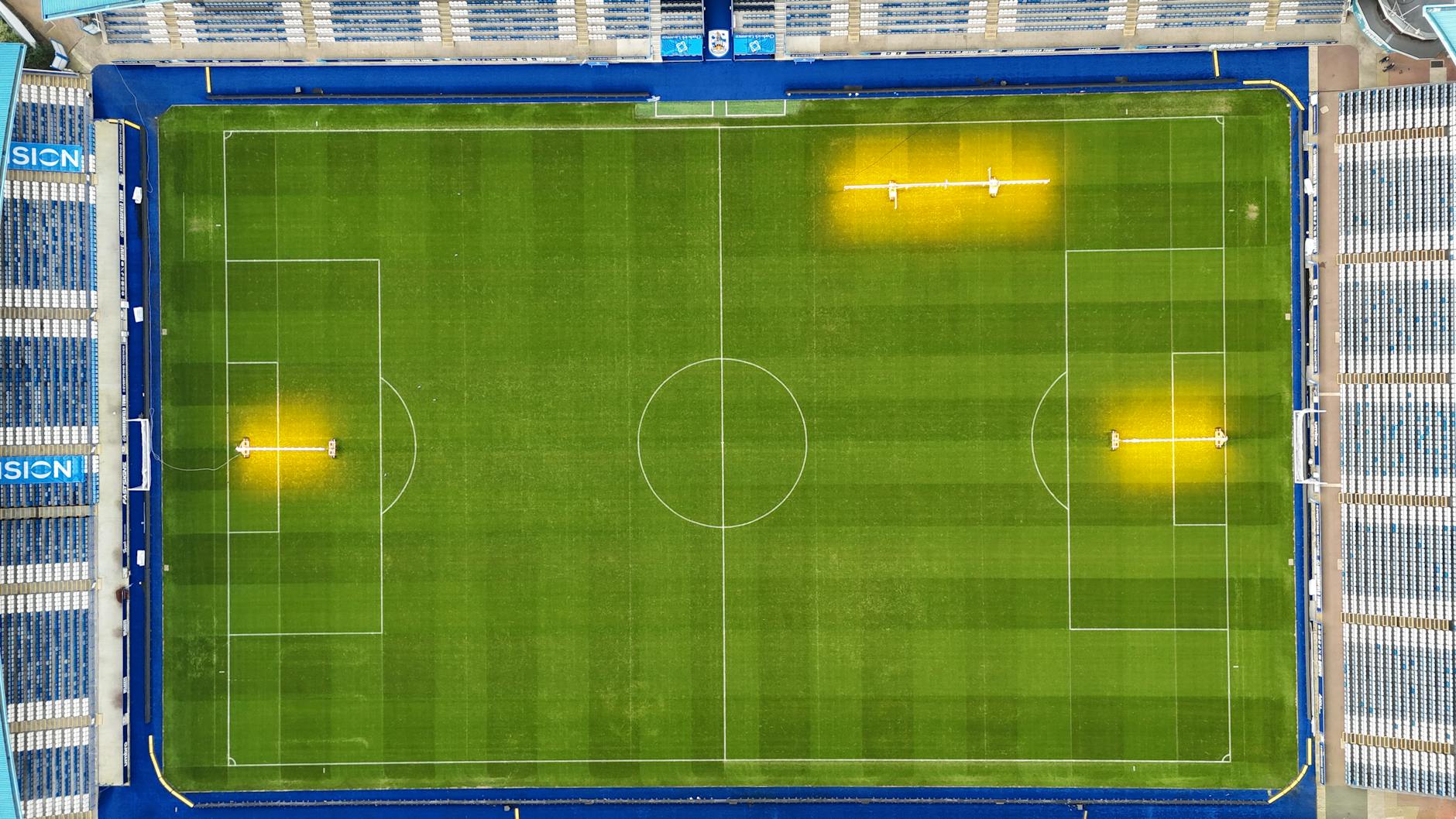
Photo by David Pickup | Advertising & Marketing 🇬🇧 on Pexels
How We Ranked Them
We ranked the five formations using four criteria: defensive stability at 30%, midfield access at 25%, attacking width at 25%, and transition flexibility at 20%. These weights favour systems that can adapt between phases rather than shapes that succeed only under one match condition.
Evaluation framework
- Defensive stability, 30%: How reliably the structure protects central and wide spaces.
- Midfield access, 25%: Whether the team can create passing angles and numerical superiority.
- Attacking width, 25%: How effectively the system stretches the opposition.
- Transition flexibility, 20%: How safely it reacts after losing or regaining possession.
Using this framework, the 4-3-3 ranks first because it scores consistently across all four categories. The 4-2-3-1 follows closely because its double pivot offers protection, although the lone striker can become isolated. The 4-4-2 scores well for stability and clarity but loses points when opponents create a three-versus-two midfield overload.
The 3-5-2 is tactically powerful when wing-backs are fit, intelligent, and supported by the outside centre-backs. The 5-3-2 ranks fifth for overall flexibility, not because it is weak, but because defensive compactness often comes at the cost of sustained possession and territorial control. This is a contrarian conclusion: the most defenders do not automatically create the safest system if the team cannot escape pressure after winning the ball.
Which Should You Pick?
Pick 4-3-3 for the broadest balance, 4-2-3-1 for central protection, 4-4-2 for clear roles, 3-5-2 for wing-back-driven overloads, and 5-3-2 for compact defending and counter-attacking. The correct choice depends on player profiles, opponent threats, fitness, and the scoreline rather than popularity alone.
For beginners, start with 4-4-2 because the lines are easy to identify. Once that feels comfortable, compare a 4-3-3 and 4-2-3-1 by focusing on the number of midfielders behind the ball. Advanced viewers should then study the 3-5-2 and 5-3-2, especially the behaviour of wing-backs during turnovers.
For FIFA World Cup 2026 analysis, venue and travel may also influence tactical choices. The tournament spans the United States, Canada, and Mexico, with matches played across different climates, altitudes, and travel distances. A coach may choose a more conservative structure late in a match played in heat, while a team needing a goal may push fullbacks higher and effectively create a 2-3-5.
Fan Strategy’s match coverage is most useful when you treat formation numbers as evidence rather than prediction guarantees. A shape can suggest where advantages may appear, but it cannot determine finishing quality, referee decisions, injuries, or the timing of substitutions.
Frequently Asked Questions
Q: What is a football formation?
A football formation is the numerical description of how a team’s 10 outfield players are arranged from defence to attack. The goalkeeper is not included, so 4-3-3 means four defenders, three midfielders, and three forwards. The notation describes the starting framework, while actual movement may create different shapes during possession and defensive phases.
Q: How do you read football formation numbers?
Read football formation numbers from left to right, beginning with defenders and ending with forwards. Add the numbers to confirm they total 10, then identify each line’s practical roles, such as fullbacks, holding midfielders, wingers, or a lone striker. Finally, compare the team’s shape with and without the ball.
Q: What is the difference between 4-3-3 and 4-2-3-1?
The main difference is midfield distribution: 4-3-3 uses one midfield line of three, while 4-2-3-1 uses a double pivot behind three advanced attacking midfielders. The 4-3-3 generally offers natural width and balanced pressing, whereas 4-2-3-1 provides extra central protection. Both can change into 4-4-2 or 2-3-5 depending on player movement.
Q: Why can a 3-5-2 become a 5-3-2?
A 3-5-2 becomes a 5-3-2 when both wing-backs drop alongside the three centre-backs during defensive phases. This gives the team five players across the defensive line and limits wide access near the penalty area. When possession is regained, the wing-backs can advance again, restoring the attacking 3-5-2 structure.
Q: Is 4-4-2 still effective in modern football?
Yes, 4-4-2 remains effective when the team shifts compactly and coordinates striker, midfield, and fullback movements. Its main weakness is a potential two-versus-three disadvantage in central midfield against 4-3-3 or 4-2-3-1. Coaches often solve that issue by narrowing wide midfielders or asking one striker to drop between the lines.
Q: What should I watch first when analysing a formation?
Watch the deepest midfielder and the fullbacks first, because they reveal how the team balances attack and defence. Then track the striker’s distance from the midfield line and count how many players remain behind the ball during attacks. These three observations often identify the functional shape within the opening 10 minutes.
Q: Does a formation predict the match result?
A formation does not reliably predict a match result because execution, player quality, finishing, injuries, substitutions, and game state also matter. It can identify likely spaces, overloads, and defensive vulnerabilities, but it should be treated as one analytical input rather than a guarantee. Use it alongside recent performance, confirmed lineups, and player availability.
The final takeaway is exact: count the 10 outfield players, observe the shape in every phase, and follow the movements that create or remove space. That method works for a local match, a Champions League fixture, or FIFA World Cup 2026 coverage across North America. Formation literacy does not make football predictable; it makes every tactical decision easier to see.
Discover more structured football analysis from Fan Strategy before the next kickoff.
[Internal Link: FIFA World Cup 2026 team tactics and match predictions]

Photo by Kaushal Moradiya on Pexels
Thank you for reading.
Fan Strategy · Editorial Archive